

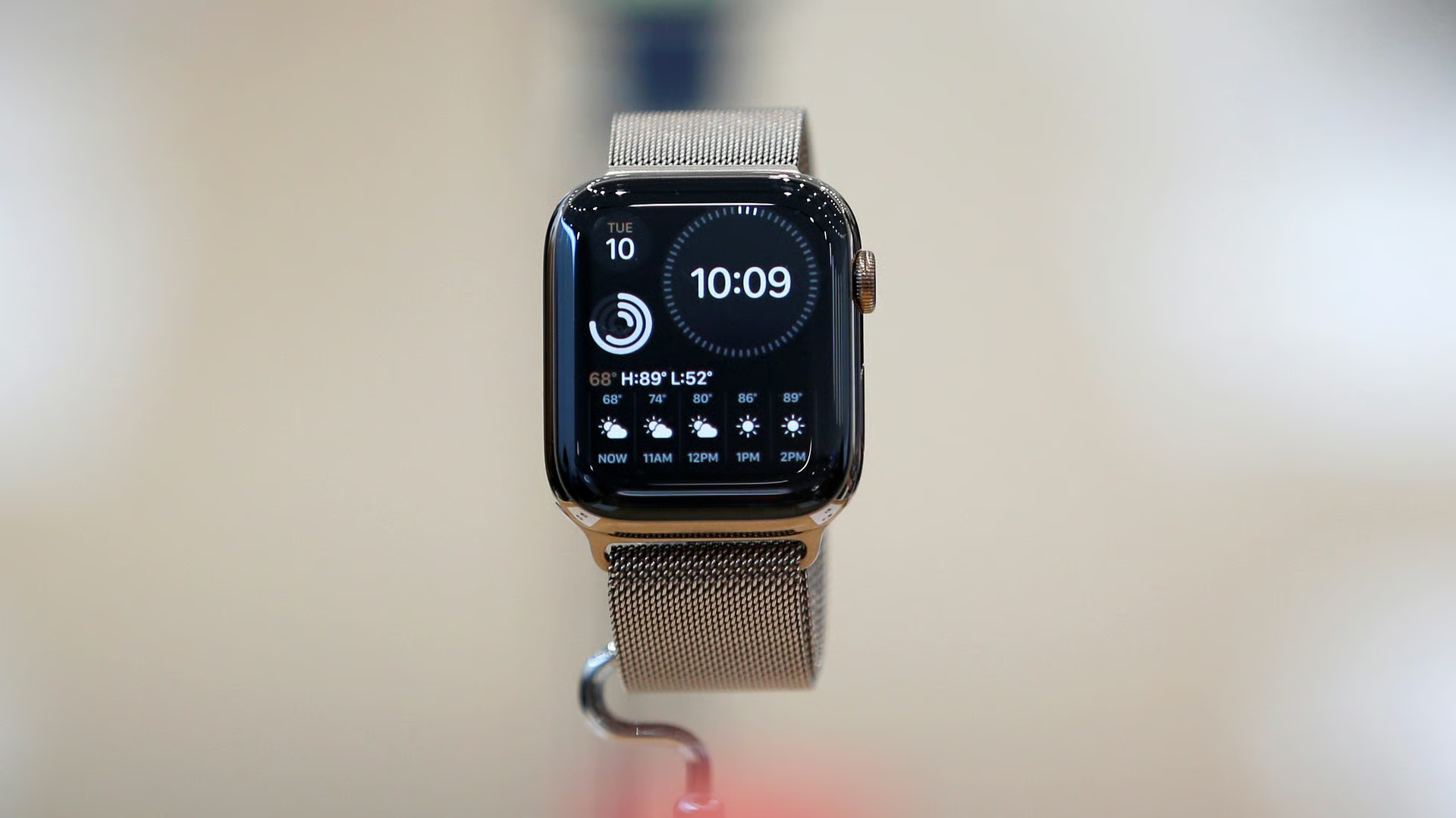
Wearable technology has evolved significantly over the past decade. Devices that were once primarily associated with fitness tracking can now monitor health metrics, display notifications, support communication, provide navigation, and interact with other digital services.
Smartwatches, fitness trackers, smart rings, wireless earbuds, and other wearable devices are becoming increasingly integrated into everyday life.
Unlike traditional computers and smartphones, wearables are designed to remain close to the user throughout the day. This allows them to collect information and provide assistance without requiring users to constantly reach for another device.
As sensors, artificial intelligence, connectivity, and battery technology continue to improve, wearable technology could become an increasingly important part of personal computing.
What Is Wearable Technology?
Wearable technology refers to electronic devices designed to be worn on the body.
Smartwatches are perhaps the most familiar example, but the category is much broader.
Fitness trackers can monitor physical activity. Smart rings can collect various measurements while remaining relatively discreet. Wireless earbuds can provide audio, communication, and increasingly sophisticated intelligent features.
Other wearables include smart glasses, connected medical devices, and specialized equipment used in professional environments.
The common feature is that technology becomes integrated into everyday activities rather than remaining on a desk or in a pocket.
1. Fitness Tracking Has Become More Accessible
One of the biggest reasons consumers purchase wearable devices is fitness tracking.
Modern wearables can record information such as steps, distance, exercise duration, heart rate, and other activity measurements, depending on the device.
This information can help users understand their daily activity patterns.
Instead of relying entirely on memory, people can look at historical information and identify trends.
For example, someone might discover that they are consistently less active on working days than on weekends.
This awareness can encourage people to make changes to their routines.
However, wearable measurements should not automatically be treated as perfectly accurate. Different devices use different sensors and algorithms, and results can vary.
2. Wearables Can Make Notifications Less Intrusive
Smartphones can generate a constant stream of notifications.
Checking every notification on a phone can interrupt work, conversations, exercise, and other activities.
A smartwatch or similar device can provide a quick way to determine whether a notification actually requires attention.
Users can glance at a message, see an incoming call, or receive an important reminder without necessarily taking their phone out.
This can reduce unnecessary interactions with smartphones.
The key is to configure notifications carefully.
If every application is allowed to send alerts, a wearable can simply become another source of distraction.
3. Smartwatches Are Becoming More Independent
Early smartwatches often functioned primarily as extensions of smartphones.
Modern devices can perform more tasks independently.
Depending on the model and connectivity available, a smartwatch may support communication, navigation, music, payments, applications, and other functions without requiring constant interaction with a phone.
This could eventually reduce the amount of time people spend using traditional smartphones for simple activities.
A user might check directions, respond to a short message, or make a payment directly from a wrist-worn device.
4. Wearables Are Expanding Health Monitoring
Health-related features have become an important part of wearable technology.
Some devices can monitor various measurements and provide users with information about their bodies and daily patterns.
This can help users become more aware of changes over time.
For example, someone might use a wearable to observe trends in activity or sleep.
However, consumer wearables should not automatically be considered medical devices.
Measurements can be affected by device placement, movement, sensor limitations, and algorithms.
For medical decisions, users should rely on appropriately qualified healthcare professionals and validated medical equipment where necessary.
5. Sleep Tracking Is Becoming Popular
Sleep is another area where wearables can provide useful information.
Many devices estimate sleep duration and identify different stages or periods of sleep based on sensor data.
This can help users recognize patterns.
For example, someone might notice that their sleep duration changes significantly depending on their schedule.
The value of sleep tracking is often less about a single night’s result and more about observing long-term patterns.
Users should also avoid becoming excessively focused on wearable-generated sleep scores. Technology can provide useful information, but it does not replace good sleep habits or professional evaluation when problems persist.
6. Wireless Earbuds Are Becoming Smart Devices
Wireless earbuds began primarily as convenient audio accessories.
They have gradually become more sophisticated.
Modern earbuds can include noise cancellation, transparency modes, touch controls, voice assistants, microphones, and other features.
Because earbuds sit close to the user, they are also well positioned to become interfaces for AI assistants.
A person could potentially interact with an AI system through spoken commands without looking at a screen.
This could make computing more natural and less dependent on visual interfaces.
7. Smart Rings Offer a Smaller Alternative
Smart rings are another growing category of wearable technology.
They can provide some of the tracking capabilities associated with smartwatches while taking up less space.
Their small size can make them less distracting for users who do not want a screen on their wrist.
Smart rings may be particularly useful for passive tracking because they can remain on the finger throughout much of the day.
However, smaller devices also face physical limitations, particularly around battery capacity and available sensors.
8. Wearables Can Support Contactless Payments
Some wearable devices can support contactless payments.
This can be convenient when users are exercising, traveling, or simply want to avoid taking their phone or wallet out.
The device communicates with a compatible payment terminal using short-range wireless technology.
Security features can help protect transactions if a device is lost, although users should understand the security controls provided by their particular payment service.
Wearable payments demonstrate how technology can increasingly disappear into everyday objects.
9. Navigation Can Become More Convenient
Wearables can also assist with navigation.
Instead of constantly looking at a smartphone screen, users can receive directions through a watch or connected audio device.
Some systems can provide vibrations or audio instructions when the user needs to turn.
This can be particularly useful when walking, cycling, or exploring unfamiliar areas.
It can also reduce the need to repeatedly take a smartphone out in public.
10. Wearables Are Becoming AI Interfaces
Artificial intelligence could significantly change wearable technology.
Instead of simply recording information, future wearables may be able to interpret it and provide personalized assistance.
An AI-powered wearable could potentially help summarize notifications, answer questions, provide reminders, recognize relevant information, or assist with daily tasks.
The major advantage is accessibility.
AI assistance could become available without requiring a user to open an application and type a request.
Voice, gestures, and other natural interfaces could become increasingly important.
11. Privacy Is a Major Concern
Wearables can collect highly personal information.
Depending on the device, this may include location, activity, sleep patterns, physiological measurements, contacts, communications, and other data.
This information can provide a detailed picture of someone’s daily life.
Consumers should therefore understand what data their device collects and how it is used.
Privacy settings should be reviewed carefully, particularly when connecting wearable devices to third-party applications.
Users should also avoid granting unnecessary permissions.
12. Battery Life Remains a Challenge
Wearable devices are small, which creates limitations.
The smaller the device, the less physical space is available for its battery.
Manufacturers therefore have to balance features, performance, sensors, screen brightness, connectivity, and battery life.
More advanced functionality can often require more power.
For some consumers, charging frequency can be an important factor when choosing a wearable.
A device with many features may not be useful if its battery cannot comfortably last through the user’s daily routine.
13. Wearables Can Become Digital Identity Tools
Wearables may increasingly play a role in authentication and identity.
A device that remains physically close to its owner could potentially be used to confirm identity for certain services.
This could make accessing devices or digital systems more convenient.
However, identity-related applications require strong security.
If a wearable becomes part of someone’s authentication system, losing the device could have consequences beyond simply losing a piece of hardware.
14. Workplace Applications Are Expanding
Wearable technology is not limited to consumers.
Businesses can use specialized wearable devices in industries such as logistics, manufacturing, healthcare, transportation, and construction.
Workers can receive instructions, scan products, access information, or communicate without constantly using a traditional computer.
In warehouses, for example, wearable scanners can help employees process inventory while keeping their hands available for other tasks.
These applications can improve efficiency, but employers should also consider privacy and employee consent when collecting data through workplace wearables.
15. The Future Could Be More Screen-Free
One of the most interesting possibilities is that wearables could reduce dependence on screens.
Smartphones have become the primary interface for many digital activities, but not every task requires a large display.
Voice assistants, earbuds, smart glasses, rings, and watches can provide information through audio, small displays, vibrations, or other interfaces.
This could lead to a computing environment in which people interact with technology without constantly looking at a rectangular screen.
The Challenges Ahead
Wearable technology still has several limitations.
Battery life, durability, comfort, privacy, data accuracy, software compatibility, and cost all influence the usefulness of a device.
There is also the question of whether people actually need another connected device.
Technology should solve a genuine problem rather than create additional complexity.
Consumers should therefore consider what they want a wearable to accomplish before purchasing one.
Conclusion
Wearable technology is changing computing by bringing digital capabilities closer to the user.
Smartwatches, fitness trackers, smart rings, earbuds, and other devices can provide notifications, activity tracking, navigation, communication, payments, and increasingly intelligent assistance.
The next stage of wearable technology could be even more significant as artificial intelligence becomes integrated into these devices.
Instead of simply displaying information, wearables may increasingly understand context and help users accomplish tasks through natural interactions.
However, the growth of wearables also makes privacy, security, battery life, and data accuracy increasingly important.
The most successful wearable devices will likely be those that provide useful assistance without demanding constant attention.
As technology becomes smaller, more connected, and more intelligent, the boundary between digital devices and everyday life may continue to disappear.